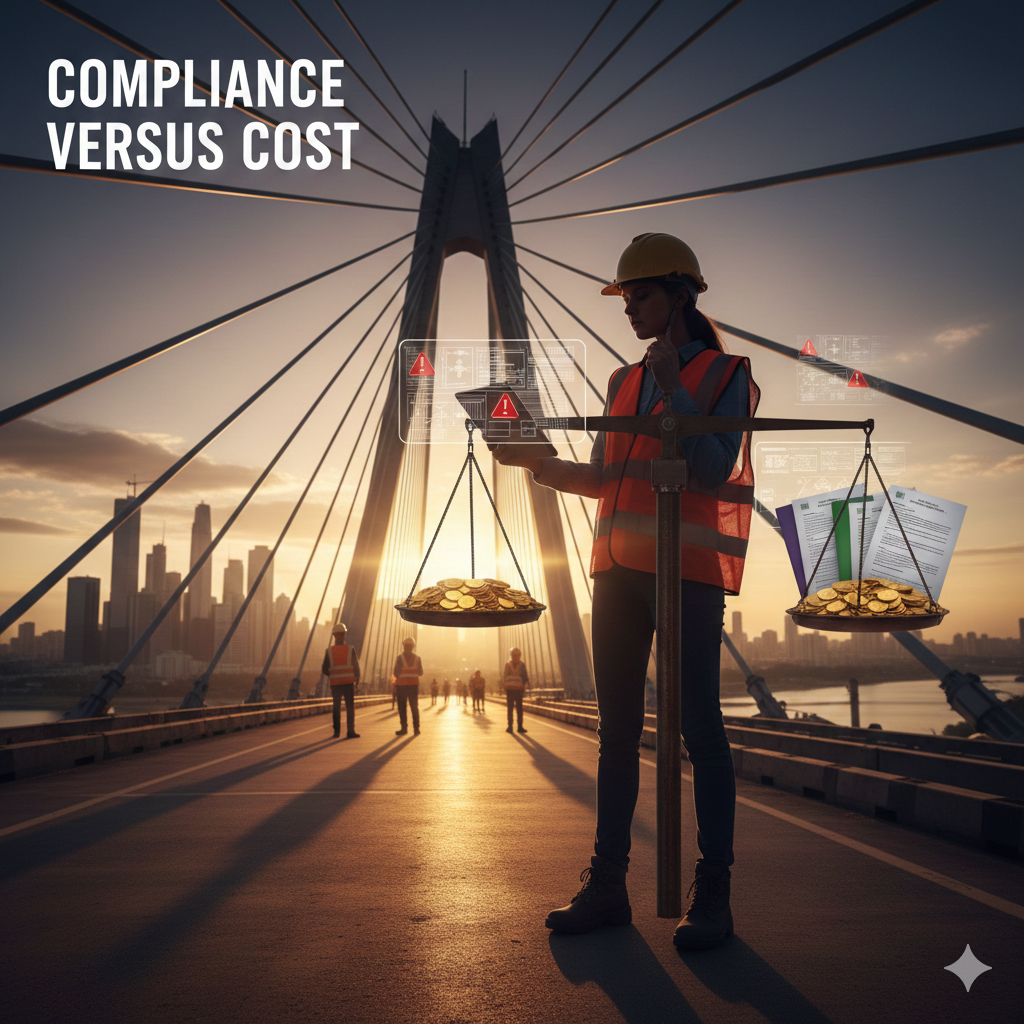
Compliance Versus Cost: The Civil Engineer’s High-Wire Act
In the world of civil engineering, every blueprint is a battleground. On one side stands Compliance—a rigid framework of safety codes, environmental regulations, and urban planning laws. On the other stands Cost—the relentless pressure of budgets, stakeholder ROI, and the ticking clock of project timelines.
While a layman might see this as a simple choice between "doing it right" and "doing it cheap," those in the trenches know it is an intricate dance of risk management and ethical fortitude.
The Hidden Complexity of Compliance
Compliance isn’t just about following a checklist; it’s about anticipating the "what ifs." For a civil engineer, the building code is the absolute floor, not the ceiling.
- The Regulatory Labyrinth: Engineers must navigate a nesting doll of jurisdictions—municipal bylaws, state environmental protections, and federal safety standards. A shift in one can render a cost-optimized design obsolete overnight.
- Future-Proofing vs. Current Standards: Compliance often lags behind innovation. An engineer might know a new composite material is superior, but if the local code doesn't recognize it yet, the cost of "proving" its safety to regulators can dwarf the material savings.
The Gravity of Cost Pressures
Modern infrastructure projects are often funded by public money or tight private equity. This creates a "value engineering" vacuum where every pound of steel and cubic yard of concrete is scrutinized.
- The Procurement Trap: Lowest-bidder mentalities often force engineers to find "efficiencies." The danger lies in the accumulation of marginal erosions—where no single cost-cut is fatal, but the sum of them reduces the project's overall resilience.
- Material Volatility: In a global economy, the cost of rebar or asphalt can swing 20% in a month. When costs spike, the pressure to "shave the margins" of compliance-adjacent features (like non-critical aesthetic reinforcements or extra drainage capacity) becomes immense.
The Ethical Intersection: Where the Rubber Meets the Road
The most intricate points of this struggle occur in the "gray zones." Consider these common dilemmas:
1. The 100-Year Flood Problem
A developer wants to build to the legal minimum for flood elevation. However, the engineer’s data suggests that climate shifts are making "100-year floods" happen every decade.
- The Conflict: Does the engineer insist on a higher (and more expensive) foundation, potentially losing the contract, or do they stick to the letter of the law while knowing the long-term risk?
2. Maintenance Debt
Cutting costs during construction often translates to higher maintenance costs later.
- The Conflict: Using a cheaper sealant might save $50,000 today but cost $500,000 in repairs in five years. Communicating this "Total Cost of Ownership" to a stakeholder focused on the quarterly bottom line is perhaps the hardest part of the job.
Finding the Equilibrium
True engineering excellence isn't found in ignoring cost, nor in skirting compliance. It’s found in Creative Optimization.
Instead of seeing them as opposing forces, the best engineers use constraints to drive innovation. They might use generative design to reduce material volume without sacrificing structural integrity, or implement "Green Infrastructure" that meets drainage compliance while doubling as a low-cost public amenity.
"The engineer's role is not just to build, but to translate the language of safety into the language of value."
Compliance is the promise we make to the public; Cost is the promise we make to the client. Balancing the two is less about math and more about the courage to uphold the integrity of the profession.